The 90 Minute Tax on Your Firm’s Best Legal Minds
The 90 Minute Tax: Why Your Best Legal Minds Start Every Day Already Behind
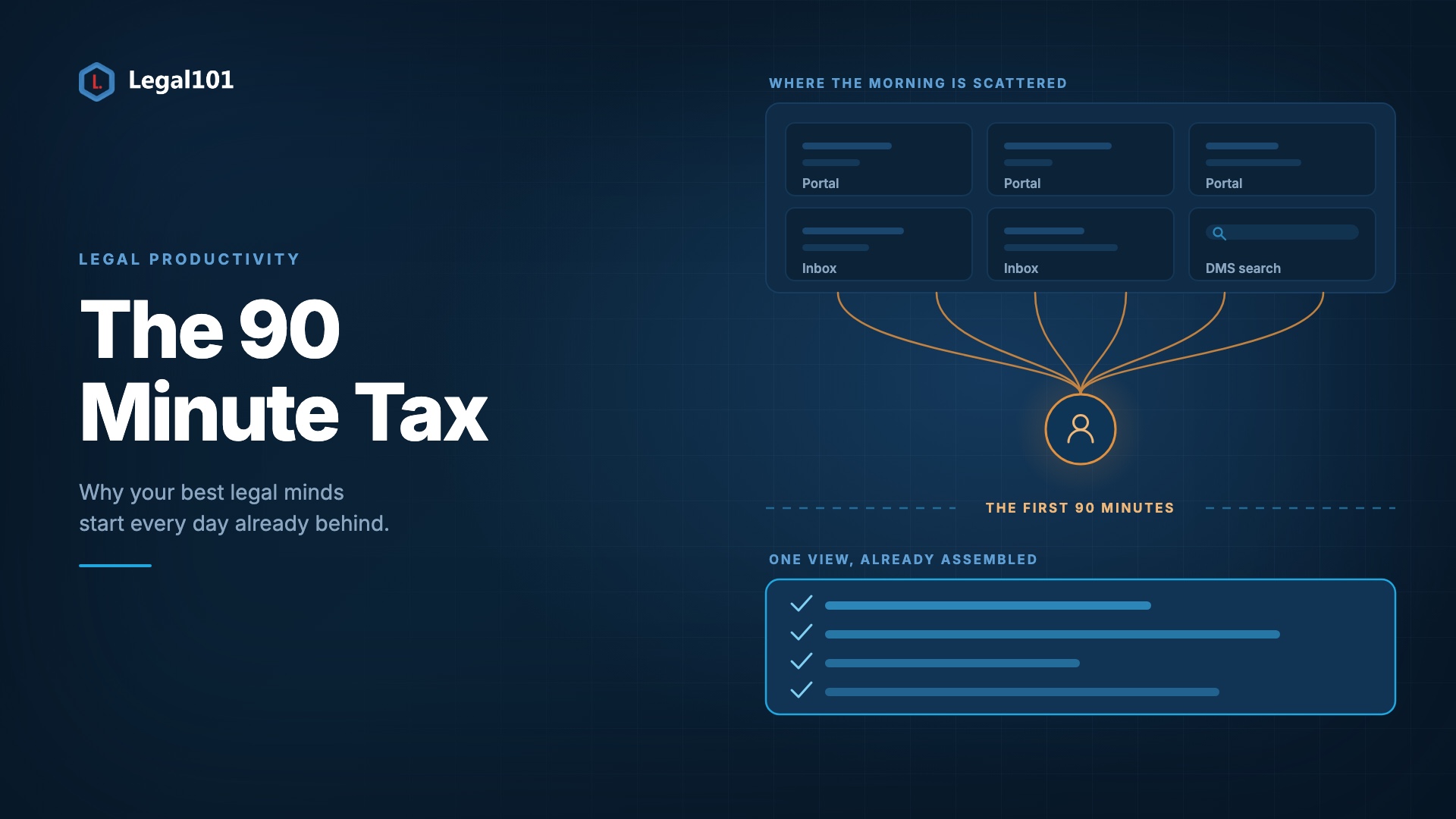
It is 7:45 a.m. A senior partner opens her laptop before coffee. Three portals, two inboxes, and a DMS search bar stand between her and one simple question: what does today actually require of me?
By the time she has pieced it together, an associate has messaged twice, a client alert sits unread, and a document needs her sign off before 9. She has not billed a minute. She has not thought about a single client problem. She has simply been searching.
Multiply that morning across every senior lawyer in your firm, every working day of the year, and a quiet but expensive pattern shows up in the numbers.
The Cost Hiding in Plain Sight
Firms measure billable hours, realization rates, and matter profitability with precision. Almost nobody measures the hours lost before the real work begins. The research suggests they should.
- A full day a week, gone. McKinsey Global Institute research found knowledge workers spend close to 20 percent of their week searching for and gathering information rather than acting on it.
- The problem has not improved. Microsoft's 2026 Work Trend Index found 62 percent of workers struggle with too much time spent searching for information, and 68 percent say they lack enough uninterrupted focus time.
- It is measurable revenue. A 2026 report from legal operations platform 8am found more than a quarter of legal professionals estimate their firm loses at least 10,000 dollars a month to administrative burden alone.
- It is also a retention risk. Research from Rev found close to four in five legal professionals report at least occasional burnout, nearly double the rate of the general working population, with partner-level attorneys among the most likely to consider leaving.
- Firms already know. Thomson Reuters found law firms rank excessive time on administrative tasks among their top two operational challenges, alongside winning new business.
Figures as reported by the sources named in each bullet.
Put simply: the people your firm can least afford to lose are the ones paying this tax most often.
Why the First Hour Carries Disproportionate Weight
This is not a generic productivity complaint. The specific window matters.
Cognitive capacity for deep, deliberate reasoning is highest early in the day and erodes with every context switch. A partner who spends that window toggling between a billing system, an inbox, an intranet feed, and a document repository is not just losing 90 minutes. She is spending her sharpest hour on her lowest value work, and reaching the actual legal problem already depleted.
For corporate counsel, the moment looks different but costs the same. A general counsel opening the day needs to know which contracts await approval, which matters moved overnight, and which risk flags need attention now, not buried three clicks into a shared drive.
Reframing the Problem: It Is Not a Search Problem
Most firms respond to this by trying to make search better. Faster indexing. Another federated search layer. More training on the DMS.
That treats the symptom. The real issue is a question ownership problem.
Every morning, each senior lawyer is personally responsible for answering three questions the firm's systems already know the answers to:
- What is on my plate today?
- What is waiting on me specifically?
- What changed overnight that I need to know about?
The systems hold this information. The lawyer does the assembly work. That is the design flaw.
What a Well-Designed Morning Looks Like
The firms and legal departments that closed this gap did one thing differently: they moved the assembly work from the person to the platform. When a senior lawyer logs in, the answer is already waiting.
What gets surfaced
- Today's schedule, deadlines, and court dates, consolidated from separate calendars
- Documents genuinely awaiting that person's sign off, not the whole team's queue
- Matter and client alerts relevant to them, filtered from general firm noise
- The small set of links and resources tied to their actual role and practice group
What makes it work
- Personalization by role, not department. What a managing partner needs at 8 a.m. is not what a knowledge manager or a second-year associate needs.
- Aggregation without migration. The DMS, billing system, and intranet stay where they are. Only the view is unified.
- Permissions inherited, not rebuilt. Nothing appears that the lawyer would not already be entitled to see, which keeps confidentiality walls intact.
- Curation over completeness. A morning view showing everything is just another portal to search. The value sits in what it leaves out.
None of this asks a lawyer to learn a new system or change how they work. It asks the systems they already use to do the searching on their behalf, before the day begins.
The Real Return Is Attention, Not Hours
CIOs and knowledge managers usually justify this kind of investment in hours saved. That number matters, but it understates the return.
What is actually protected is a senior partner's capacity for judgment, at the one moment in the day when that judgment is sharpest.
Firms competing for lateral talent, client trust, and partner retention are increasingly judged on something less visible than billing rates: whether their best people spend mornings thinking, or searching.