The Hours You Already Worked, But Never Billed
The Hours You Already Worked, But Never Billed
Everyday work like reading updates and filing emails rarely gets billed. Here is why firms are losing money they already earned, and what leaders can do about it.
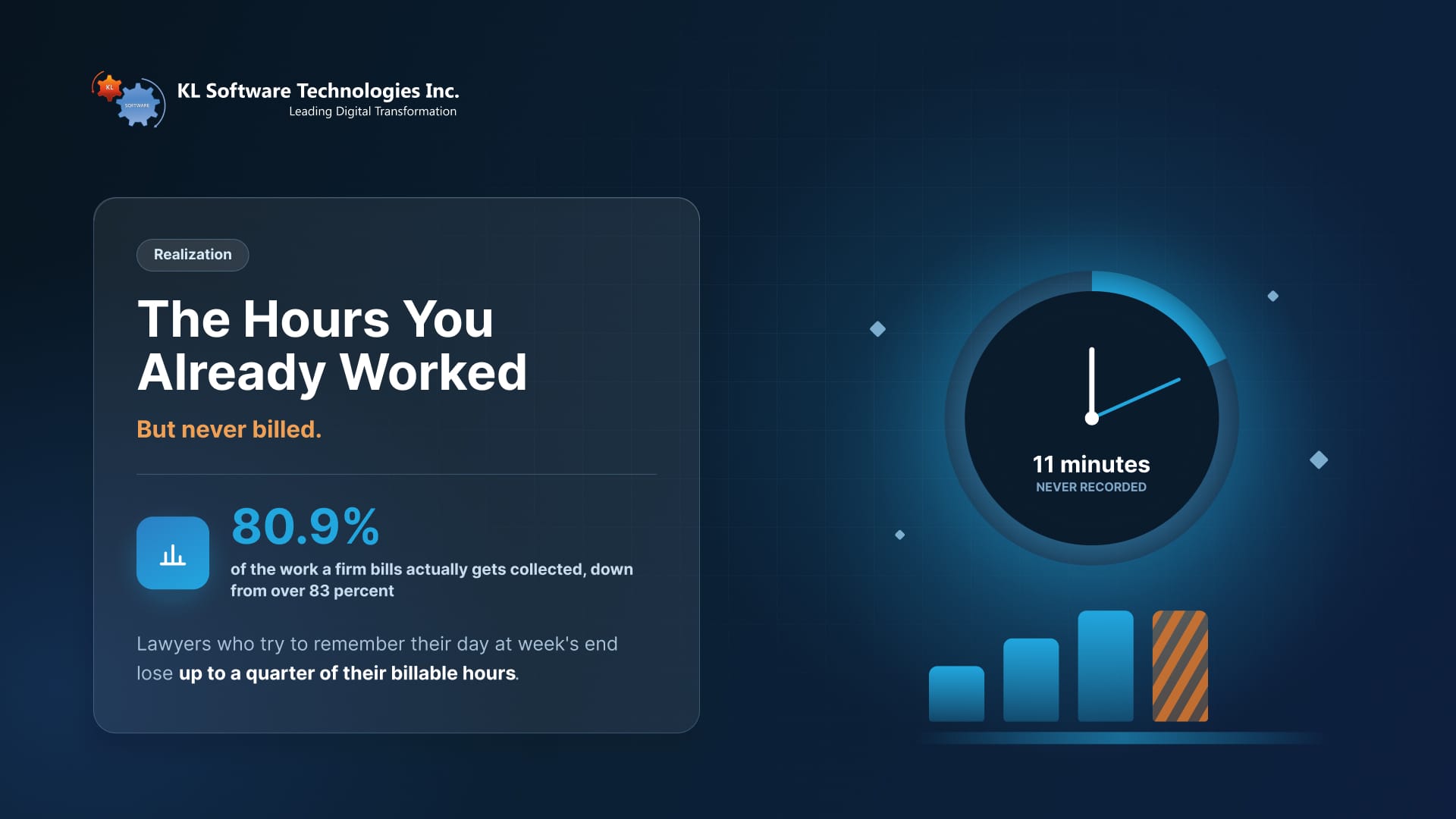
Picture a senior associate on an ordinary Tuesday. She reads a discovery update from opposing counsel, sends a two-line note warning the client about a scheduling risk, and files three emails into the case folder. Eleven minutes, maybe twelve. None of it ever makes it onto her timesheet. By Friday, she forgot it even happened.
Now multiply across every lawyer, every case, every week, at a mid-size firm. You get a number that finance leaders do not enjoy saying out loud.
Why Are Firms Losing Money Already Earned?
For years, this was treated as a training problem: bill more carefully and it goes away. The numbers tell a different story.
Am Law 100 firms just posted their lowest realization rates in five years. Realization rate simply means how much of the work a firm bills actually gets collected. Industry data puts that number around 80.9 percent today, down from over 83 percent just a few years ago. Across the wider market, the picture is similar: firms are collecting under 750 dollars for every 1,000 dollars of work they actually do.
The real problem is usually under-recording, not overbilling. Lawyers who try to remember their day at week’s end lose up to a quarter of their billable hours, because quiet, everyday work like reading a case update or clearing an inbox never gets written down.
Why This Is Becoming a Bigger Risk, Not Just a Revenue Problem
Missing hours used to be a quiet money problem. It is now turning into a compliance problem too. Corporate legal departments spend a median of 1.8 million dollars a year on outside law firms. As AI tools help lawyers draft and summarize faster, corporate clients are rewriting their billing rules to close the gap between how long work used to take and what firms still charge for it. In the past year and a half, several large companies have updated their outside counsel rules to require firms to disclose AI use and justify their hours.
This puts firms in a tight spot. Bill the old, higher hours for work that AI has already sped up and risk a client dispute or an ethics complaint. Fail to record the AI-assisted work at all, and the revenue gap only gets worse. Neither choice is good for the firm.
Turning Everyday Work into Billing You Can Stand Behind
The answer is not to make Copilot decide what a lawyer should bill. It is to use Copilot to make the work of recording time easier, faster, and more complete.
Microsoft 365 already contains useful signals about the work happening throughout a lawyer’s day: emails exchanged, documents reviewed, drafts created, meetings attended, and matter-related files worked on. On their own, those signals are not a timesheet. But with the right workflow, they can provide the starting point for one.
A Copilot-powered workflow can bring those signals together, organize potentially billable activity by matter, and draft time entries with descriptions that reflect the work performed. It can also apply the firm’s billing policies and client-specific guidelines to flag entries that may need attention.
The lawyer remains in control. They review the suggested entries, correct anything that is inaccurate or non-billable, and approve the final record before it reaches the firm’s billing system.
The workflow looks something like this:
That distinction matters. The goal is to reduce the amount of work required to reconstruct a day accurately and give lawyers a better starting point than a blank timesheet.
For CIOs and knowledge managers, that makes the opportunity less about replacing timekeeping and more about connecting systems that already exist. Microsoft 365 provides the work context. The copilot provides an intelligence layer. The firm’s billing platform remains the system of record.
And the lawyer remains the final authority over what gets billed.