Legal101 Solving the Lateral Integration Crisis
Solving the Lateral Integration Crisis: How Persona-Driven Knowledge Systems Speed Time-to-Billability
When a lateral hire joins a firm, the first 90 days rarely go the way anyone usually plans. The signing bonus is banked, the biography goes live on the website, and the new hire is expected to start generating revenue almost immediately. Instead, many spend their first six months on something far less billable: figuring out who knows what.
This is not a training problem. It is an information architecture problem, and hybrid work has made it worse.
The Hidden Cost of the First Six Months
The numbers behind this are no longer theoretical.
Figures as reported by the sources named on each card.
The cost, therefore, is not limited to recruiting a replacement. Firms also lose the investment made in getting lawyers productive, integrating them into teams, transferring client relationships, and building institutional knowledge around them. That makes time-to-productivity an important part of the lateral hiring equation.
Why the PDF Binder Stopped Working
The old onboarding model relied on proximity. A new associate wandered the hallway, sat in on a matter they weren't staffed on, and absorbed institutional knowledge simply by being present. Hybrid and remote arrangements have removed that informal channel, and the PDF orientation binder that used to fill the gap was never built to replace it.
What a Persona-Based Portal Actually Solves
Most SharePoint legal intranets were built as static bulletin boards, a single homepage serving litigators, transactional lawyers, paralegals, and partners alike, regardless of what each of them actually needs on a given day. A persona-based portal, tuned to role and practice group instead of one layout for everyone, changes that by surfacing the right resources to the right person automatically.
For the litigation associate above, that means:
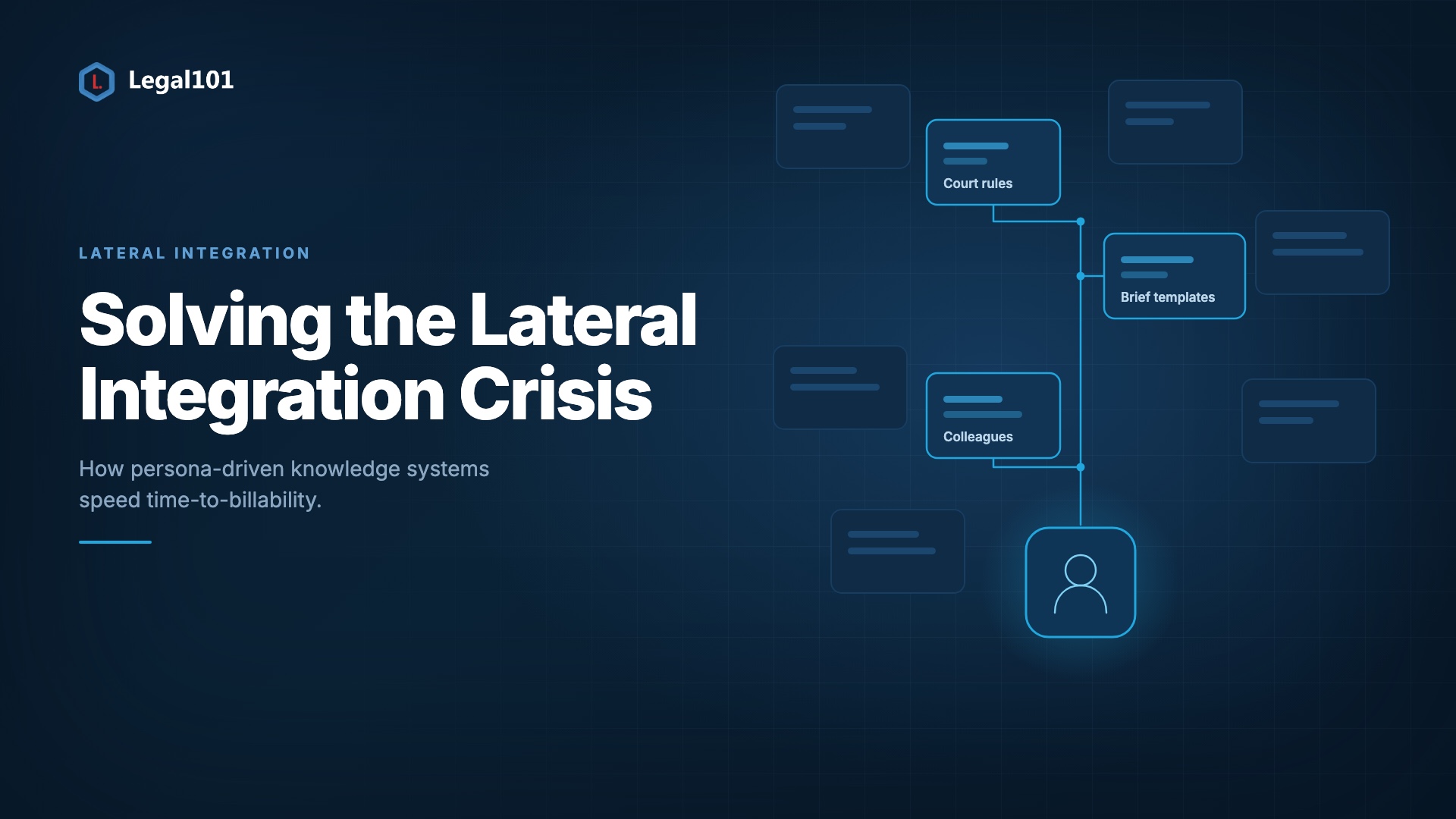
- Court rules for specific jurisdiction, filtered automatically
- Brief and motion templates specific to practice group
- A directory of colleagues who have handled similar matters before
The same associate, on a persona-driven system, finds all three in her first week instead of her third month.
AI Raises the Stakes on Fast Integration
This shift matters even more as AI changes how associates spend their time. As routine research and drafting become increasingly supported by AI, associates can spend more time on work that requires legal judgment, context, and client understanding.
For new associates to contribute to that work, they need to learn the firm's way of working quickly: which precedents to rely on, how a partner approaches an issue, what the firm's drafting standards are, and who to involve when a matter requires specialized expertise. The faster a new lawyer can navigate that institutional knowledge, the sooner they can contribute to higher-value work.
That is also where firms find their AI investment either lands or stalls, a pattern we looked at in Why Half Your AI Seats Sit Idle.
Ownership, Not Just Access
Giving lawyers access to more information does not automatically make onboarding better. Effective integration also requires a structured approach to learning and development. McKinsey's legal operations research highlights the importance of substantive orientation, targeted learning agendas, clear career-progression frameworks, and ongoing expertise development.
- Substantive orientation Orientation that covers the substance of the work, not only the administration around it.
- Targeted learning agendas A plan built for this lawyer and this practice, rather than one curriculum issued to everyone.
- Clear career-progression frameworks A stated path, so a new lawyer knows what advancement looks like at this firm.
- Ongoing expertise development Development treated as continuous, not as something that ends when onboarding does.
Thomson Reuters' research on lateral integration makes a similar point from the talent side. Dedicated integration managers and structured client-relationship mapping can help laterals build connections and become established within the firm, yet many firms still approach integration informally rather than as a defined process with clear ownership.
This is the key distinction: technology can make knowledge easier to access, but firms still need people, processes, and clear ownership to turn that access into effective integration.
The Bottom Line for CIOs and Knowledge Managers
The lateral integration crisis is ultimately a data and design problem before it is a culture problem. The underlying approach to firm-wide knowledge organization reflects this: new attorneys succeed faster when institutional knowledge is organized around who needs it, not simply where it happens to already sit.
That is the premise behind Legal101, a legal intranet on Microsoft 365 SharePoint whose search answers according to who is asking, and it is the same principle behind people-first intranet design: organize around the person with the question, not the department that produced the document.
Firms that treat onboarding as an afterthought will keep absorbing six-figure losses with every departure. Firms that invest in persona-driven infrastructure, backed by clear ownership and measurable milestones, will get new talent to billability faster, and keep more of that talent in the building long enough for it to matter.