Version Control Risk in AI Co-Authored Legal Documents | Microsoft Copilot Consulting
When Everyone Edits at Once: The Version Chaos Hiding Inside AI Co-Authoring
It is 11 p.m. the night before signing.
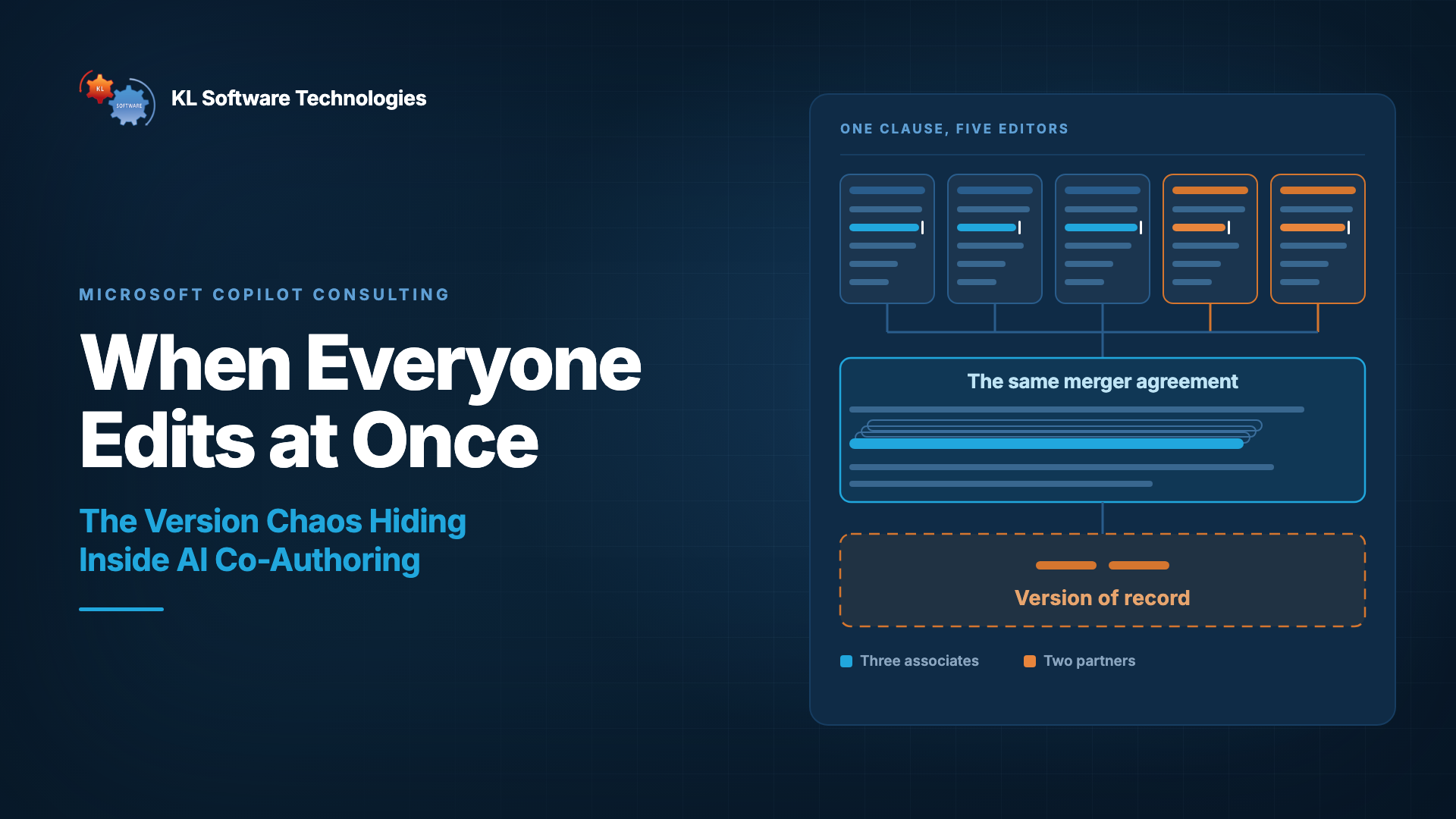
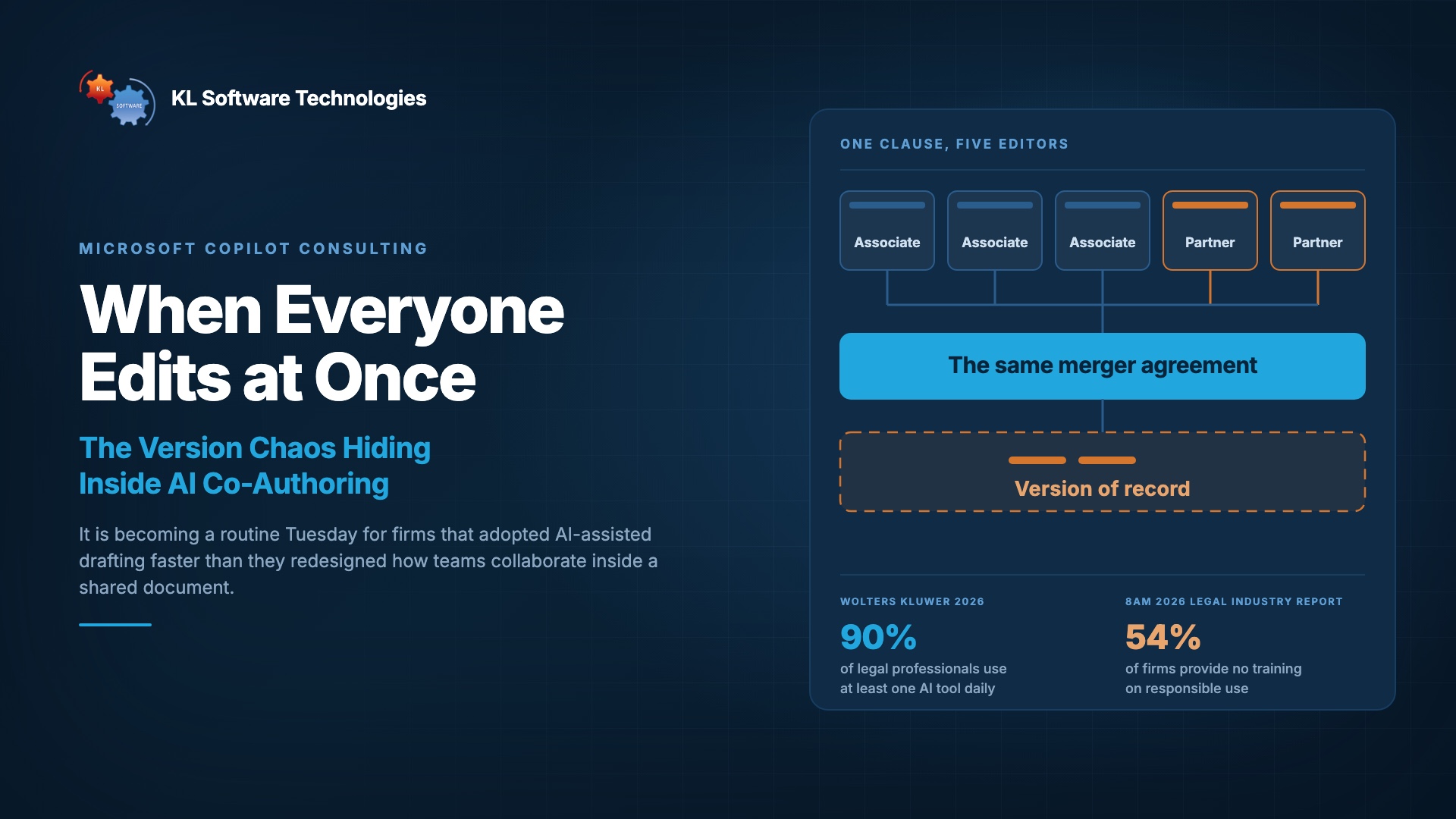
Three associates and two partners are working inside the same merger agreement, each with Copilot open in a separate window, each asking for a cleaner version of the indemnification clause.
By morning, nobody can say with certainty which paragraph reflects the negotiated position and which one is a machine's best guess that got saved over it.
This is not a hypothetical.
It is becoming a routine Tuesday for firms that adopted AI-assisted drafting faster than they redesigned how teams collaborate inside a shared document.
Adoption Moved Faster Than the Workflow
The numbers explain why this is happening now, not five years from now.
-
Wolters Kluwer's 2026 Future Ready Lawyer Survey found that more than 90 percent of legal professionals now use at least one AI tool daily.
-
Loyens & Loeff recorded a 94 percent active user rate on Microsoft 365 Copilot and logged over one million Copilot prompts in a six month window, according to Microsoft's own customer research.
-
DLA Piper's early Copilot pilots showed content generation and data analysis time savings of up to 36 hours a week for individual users, per the firm's Chief Innovation Officer.
The pace is unlike anything the profession has seen. But speed at the individual level does not translate into order at the team level. One lawyer using AI assistance alone speeds up a single mind.
Three or four using it inside the same live document at once start speeding up a collision.
Where the Collision Actually Happens
Ask any knowledge management lead who has watched a live negotiation session and the pattern repeats itself:
- An AI-suggested edit overwrites a colleague's still-open redline before either version has been reviewed.
- Two AI-generated versions of the same clause exist at once, and the document keeps whichever was saved last, not whichever was legally correct.
- The edit history shows a suggestion was accepted, with no record of which matter standard, clause library entry, or approving partner it was checked against.
- A reviewing partner cannot tell, at a glance, whether a paragraph reflects a negotiated position or a model's best guess dropped into the file minutes earlier.
Why This Is a Corporate Counsel Problem, Not Just an IT One
The American Bar Association's Model Rule 1.1, Comment 8, ties the duty of competence to understanding the benefits and risks of relevant technology, and more than 40 states have adopted it.
That duty does not pause because a document had three simultaneous editors instead of one.
Governance has not kept pace with usage.
The 2026 Legal Industry Report from 8am found that 54 percent of firms provide no training on responsible generative AI use and have no plans to introduce any.
Privilege, malpractice exposure, and courtroom credibility all rest on being able to show which version of a document is the version of record.
Unmanaged concurrent AI editing quietly erodes that certainty.
What Actually Closes the Gap
The fix is not fewer AI tools. It is more structure around how several people use them together on the same file.
- Version-lock protocols: while a document is under active negotiation, one role holds the master copy, and concurrent contributors move through defined check-in and check-out steps rather than open, simultaneous editing.
- Custom track-changes workflows: the drafting environment is configured so AI-suggested language is visually distinct from human edits and requires a deliberate acceptance step before it becomes part of the working draft.
- Staging branches: drafting happens in an isolated copy tied to matter metadata, the matter number, the applicable clause standard, the reviewing attorney, before anything merges into the version everyone ultimately signs.
The differentiator is not the AI itself. It is the document governance wrapped around it, decided before the deal, not during it.
The Firms Already Ahead
A recent eGroup poll of law firm CIOs and partners found that around 90 percent of respondents already use Copilot for document drafting and summarization, the single largest use case in the room.
Yet broader workplace research from Recon Analytics, spanning more than 150,000 respondents, puts real seat-to-habitual-use conversion at closer to 36 percent.
Most licensed users are still working without a defined process around the tool.
DLA Piper took a different route.
Rather than issuing licenses and hoping for the best, the firm built a dedicated adoption task force and a shared prompt repository before scaling access firm-wide, treating the collaboration model as deliberately as the software itself.
The Bottom Line for the C-Suite
The lesson is not to slow down adoption.
It is to decide, before the next merge conflict happens at midnight, who holds the pen, what counts as the version of record, and how a machine-suggested clause earns its way into a document a client is about to sign.
Firms that answer those questions in advance are the ones turning AI-assisted drafting into a genuine advantage rather than a new source of risk.