The Context Gap: Why Your Firm’s AI Strategy Needs More Than a Smarter Chatbot
The Context Gap: Why Your Firm’s AI Strategy Needs More Than a Smarter Chatbot
How law firms and corporate legal departments are moving toward AI that understands the context behind the work
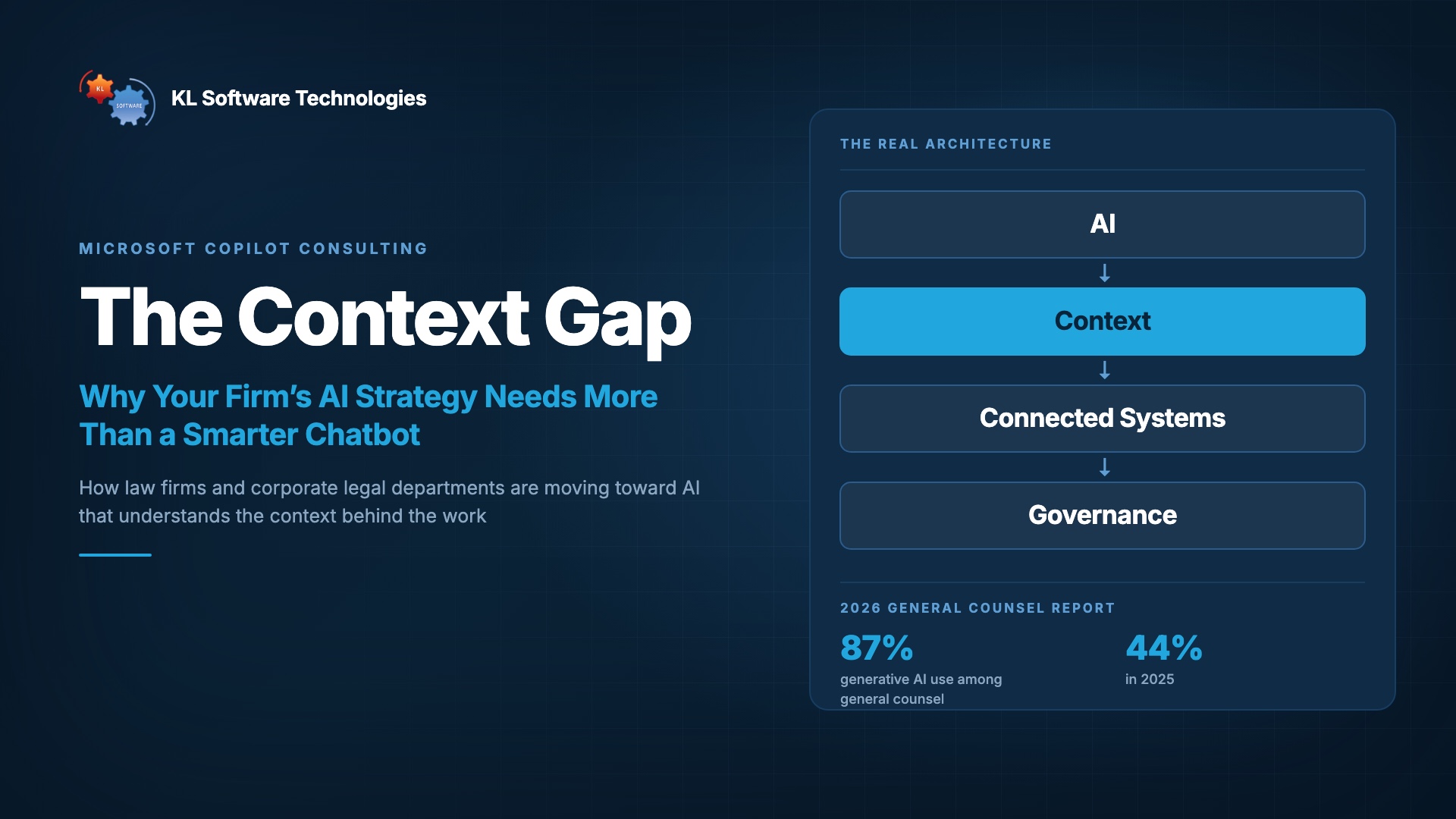
According to the 2026 General Counsel Report from FTI Consulting and Relativity, generative AI use among general counsel reached 87%, nearly doubling from 44% in 2025.
But as adoption grows, the focus is shifting.
The question is can AI generate that answer with the right context.
A legal matter may involve years of documents, recent emails, multiple contract versions, client requirements, internal precedents, and strict access controls.
The AI becomes more useful when it can work with that information.
That is the context gap.
Legal Work Does Not Happen in One Place
Consider a simple request:“Draft a response to opposing counsel.”
The drafting itself is only one part of the task.
The response may depend on:
- The latest redline
- Previous negotiations
- Existing consents
- Client-specific guidelines
- Internal legal precedents
- The lawyer’s access to the matter
That information may sit across the firm’s document management system, Microsoft 365, practice management platform, knowledge repositories, and research systems.
The challenge is bringing the right information into the workflow at the right time.
This is where the next generation of legal AI is taking shape.
From Standalone AI to Connected AI
For years, connecting AI to these systems required separate integrations.
Each system could require its own connector, authentication process, data mapping, and ongoing maintenance.
That made the technology behind AI increasingly complex.
New standards are beginning to simplify this connectivity.
One of the most important developments is the Model Context Protocol (MCP). The open standard provides a common way for AI systems to connect with external tools and data.
Microsoft has also introduced MCP support in Copilot Studio and federated connectors for Microsoft 365 Copilot.
The direction is clear: AI is becoming less of a standalone destination and more of a layer that can work across an organization’s existing systems.
The Context Must Follow the Permissions
For legal teams, access is just as important as connectivity.
A system that can reach more information must also understand who is allowed to see what.
That means preserving:
- Matter-level permissions
- Ethical walls
- Client confidentiality
- Role-based access
- Document-level restrictions
- Existing security policies
Federated access can help by allowing AI to retrieve information from connected systems at the time of a query while applying the user’s existing access rights.
The objective is simple: Give AI the context it needs without giving it access it should not have.
That distinction will become increasingly important as firms connect AI to more of their knowledge infrastructure.
The Next AI Strategy Is About the Layer Behind the AI
Gartner expects 40% of enterprise applications to carry task-specific AI agents by the end of 2026, compared with under 5% the previous year.
As these agents become part of enterprise software, firms will need to think beyond the AI model itself.
The real architecture will increasingly look like:
The line above is the source’s own, arrow characters included. Context carries the solid fill because it is the layer this article is named for.
The model provides intelligence.
The connected systems provide the firm’s knowledge.
The context determines what information matters to the task.
Governance determines what the AI can access and do.
Together, these layers make AI more useful within real legal workflows.
The Opportunity: AI That Understands the Work
Return to that Friday evening.
A general counsel is working on a live dispute and asks AI to prepare a response.
Instead of starting with a blank prompt, the system can work with the relevant matter context: the latest documents, previous communications, client requirements, and the user’s existing permissions.
The result is not simply a well-written response.
It is a response grounded in the work already happening inside the firm.
That is where legal AI is heading.
The next competitive advantage will not come only from having access to a more powerful AI model.
It will come from connecting that intelligence to the firm’s documents, knowledge, systems, permissions, and workflows, so AI can work with the context that makes legal work possible.