When Judges Ask About AI: Is Your Law Firm Ready?
When Judges Ask About AI: Is Your Firm Ready?
A courtroom question is becoming a standard part of legal work. Firms need more than an AI policy, they need a clear record of what happened.
In June 2023, a lawyer appeared in a Manhattan courtroom with six legal cases in a brief that did not exist.
The lawyer had asked an AI tool to find supporting cases. The tool produced convincing citations, complete with case names, quotes, and legal reasoning. The problem? None of them were real.
The judge did more than issue a penalty. During a hearing, the lawyer was asked a simple question again and again: did you check whether the cases were real?
The answer was no.
That incident became one of the best-known warnings about AI in legal work.
So the question is: what happens when a judge asks a firm to show its work?
Courts Are Asking for Proof, Not Just Promises
AI requirements are increasingly becoming part of court filings. Depending on the court, lawyers may need to disclose AI use, confirm human review, verify citations, or certify that the filing meets the court's requirements.
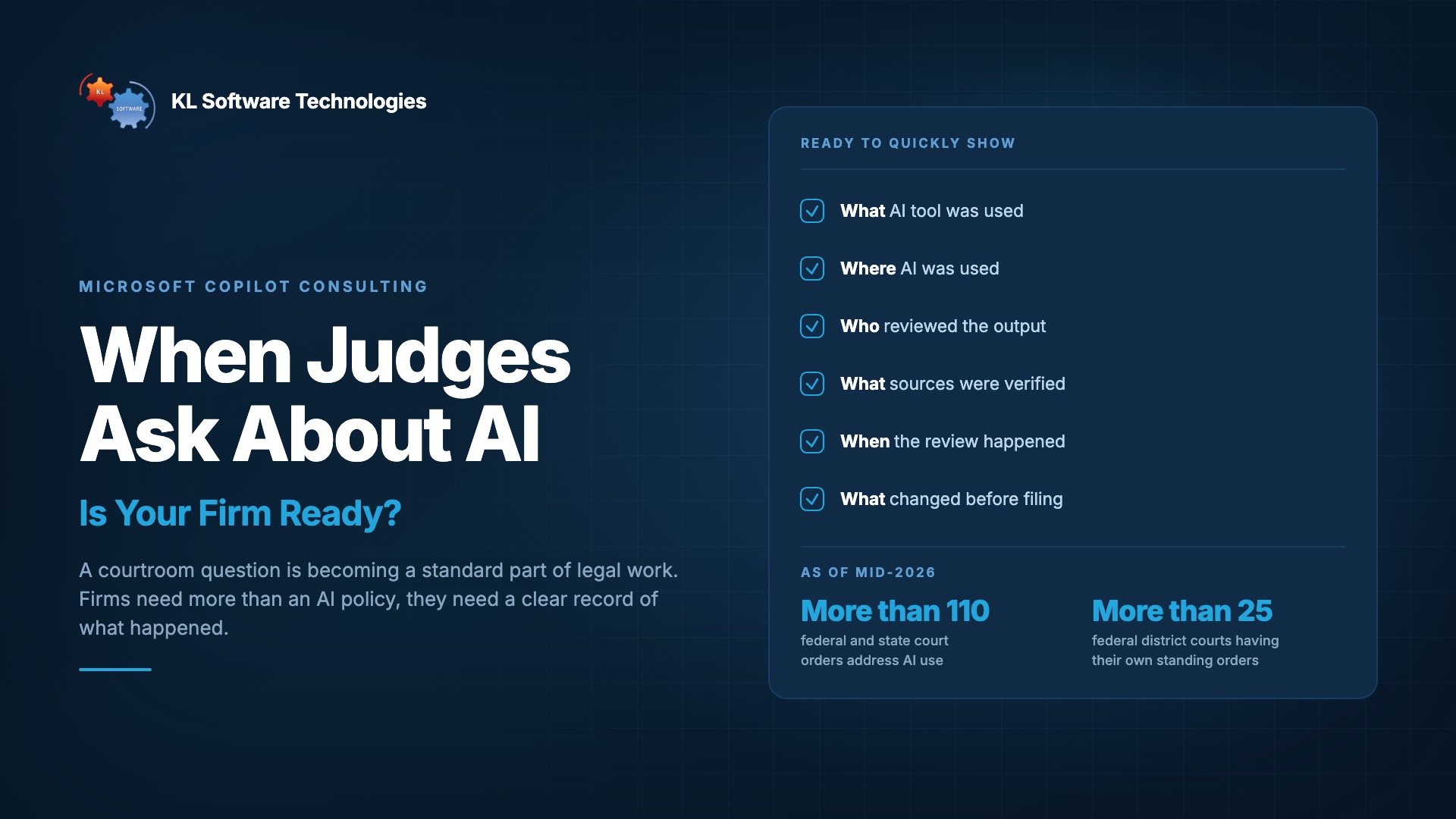
More than 110 federal and state court orders reportedly address AI use as of mid-2026, with more than 25 federal district courts having their own standing orders.
Both counts come from the sentence above. Both of them move, so see the fact-check note on the SEO sheet before publishing.
That means a firm should be ready to quickly show:
- What AI tool was used
- Where AI was used
- Who reviewed the output
- What sources were verified
- When the review happened
- What changed before filing
The challenge is that most AI policies only say what lawyers should do. They do not create evidence that it actually happened.
The Missing Piece: A Record Built Into the Workflow
Legal work already has a paper trail. Drafts, redlines, comments, and final documents live in the firm's document management system.
AI work often does not.
A lawyer may use an AI assistant in one window, move the output into a document, review it somewhere else, and eventually file it. The work happened, but the record is scattered.
Most of this drafting already happens inside Microsoft Copilot, in Word, Outlook, and Teams, tools lawyers use every day. The gap is not the AI itself. It is the missing connection between what Copilot produces and where the matter actually lives, the firm's document management system. Closing that gap means configuring Copilot for the firm's environment, not bolting on a separate tool. In practice, that means:
Capture AI assistance. Copilot is set up so that when it drafts or researches something in Word or Outlook, the prompt and the resulting draft are saved automatically to the correct matter file, instead of staying in a chat pane that disappears the next day.
Track human review. Once that draft moves into the document, every edit, comment, or approval a lawyer makes is logged and tied to that same matter, with a name and a timestamp attached.
Preserve the final trail. These records roll up into a single, audit-ready view per matter, showing the complete path from the first Copilot draft to the version that was reviewed and filed.
So instead of trying to reconstruct what happened later, the firm has a simple record:
If a judge or client asks, the firm can show the process instead of relying on someone's memory. This is the practical difference between simply having Copilot and having a Copilot deployment built for legal accountability.
The tool stays the same. What changes is whether the work leaves a trail.
The Real Advantage: Being Ready to Answer
This goes beyond court compliance.
Clients are increasingly asking how outside counsel uses and reviews AI-assisted work. Firms that can demonstrate a controlled process have something stronger than a policy, they have evidence.
Don't just say AI use is controlled. Be able to show how.