Matter Budget Overruns: Why Law Firms Find Out Too Late
Why Law Firms Keep Discovering Budget Overruns Too Late
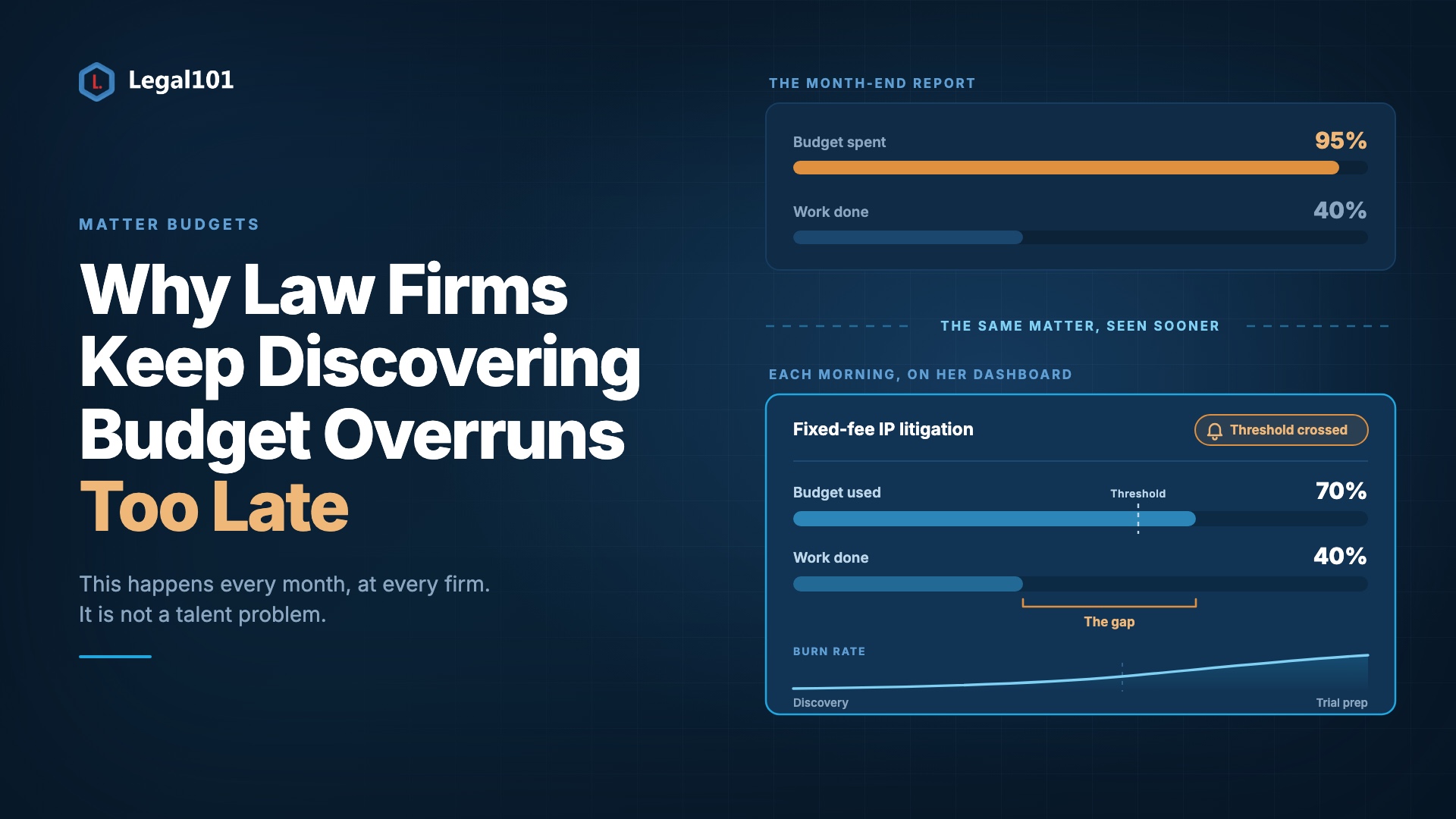
A fixed-fee IP litigation matter, three months in. The lead partner feels good about progress. Then billing closes the month and the report lands: 95 percent of budget spent, only 40 percent of the work done. Now comes the client call nobody wants to make, and a write-down nobody planned for.
This happens every month, at every firm. It is not a talent problem. It is a visibility problem, and in 2026, it is one clients no longer tolerate.
The Real Problem: Nobody Sees the Overrun Until It Is Too Late
Most matters are still tracked the old way: hours logged, invoice generated, report pulled at month-end. By the time anyone can act, the spend has already happened.
Here is what that costs the industry:
- Nearly 90 percent of legal spend is still billed hourly, so overruns build up quietly, invoice by invoice, until one finally forces the conversation.
- Legal ops firm Swiftwater & Company puts it simply: spend creep is invisible until it is too late, because nothing is actively tracking cumulative cost against the original scope.
- Without a trigger to flag it, overruns basically approve themselves. Outside counsel keeps billing, the client keeps paying, and the drift is only discovered once the final number is too big to ignore.
Budgets are also tighter than ever. The 2026 ACC Law Department Benchmarking Report found 77 percent of legal departments now run on fixed budgets, while the average lawyer supports far more of the business than a few years ago. Less room, more pressure, same old reporting cycle.
Why Clients Now Judge Firms on This
Clients have stopped treating billing surprises as normal. Miss the mark once, and a general counsel rarely gives a second chance.
A few ways this shows up today:
- GCs benchmarking firms for a panel spot now ask how spend gets tracked, not just what the rate card says.
- A client on a fixed fee expects a heads-up at 60 percent of budget, not at 95 percent.
- RFPs increasingly list "proactive cost visibility" as a selection factor, right next to rate and experience.
This is also why alternative fee arrangements have become a growth lever rather than a discount tactic. Over half of in-house teams are actively seeking AFAs, and a firm's willingness to offer them now shapes who gets picked. But here is the catch: an AFA only protects margin if someone is watching consumption against progress while the matter is still open. Promise a fixed fee with no visibility, and the firm has just agreed to quietly absorb every overrun itself.
The real question for a managing partner is not "did we lose money on that matter." It is "how would we have known sooner, and who would have seen it first."
The Fix: Put the Numbers in Front of the Person Who Can Act
A monthly report a billing coordinator checks cannot answer that question. Something that shows budget health to the lead partner, updated as the work happens, can.
Picture the same litigation partner from the opening story. Instead of finding out at month-end, she opens her own dashboard each morning and sees two numbers side by side for every open matter: how much budget is used, and how much work is actually done.
That single comparison changes everything:
- At 70 percent budget and 40 percent complete, she sees the gap immediately, not weeks later.
- A trend line shows whether the burn rate is speeding up as the matter moves from discovery into trial prep.
- An alert fires automatically once a matter crosses an agreed threshold, so escalation happens by design, not by chance.
She can now reallocate a junior associate, renegotiate scope with the client, or simply flag the risk early, while there is still time to do something about it.
What This Means for CIOs and Knowledge Managers
Most legal tech investment has gone into drafting and research speed. That misses where the financial exposure actually sits. Giving lead counsel a live view of budget versus progress, inside the tools they already use, turns them into active managers of matter economics instead of passengers who find out after the fact.
For any firm betting on AFAs to win and keep institutional clients, this is not optional. It is the difference between an AFA that protects margin and one that slowly erodes it, one unwatched matter at a time.
Frequently Asked Questions
What causes legal matter budget overruns?
Overruns usually come from a reporting gap, not a spending problem. Most firms only see cumulative spend against budget at month-end, so a matter can drift past its agreed scope for weeks before anyone with authority to act finds out.
How can law firms track AFA profitability in real time?
By pairing budget consumption with matter completion status at the individual matter level, updated continuously rather than monthly, with automatic alerts when a matter crosses a defined spend threshold relative to its progress.
What is matter-level financial visibility in legal operations?
It is the practice of surfacing budget-to-completion data directly to the lead timekeeper on a matter, inside their normal workflow, so financial risk is visible while there is still time to adjust staffing, scope, or client communication.