AI Transparency for Law Firms: What Clients Want to Know
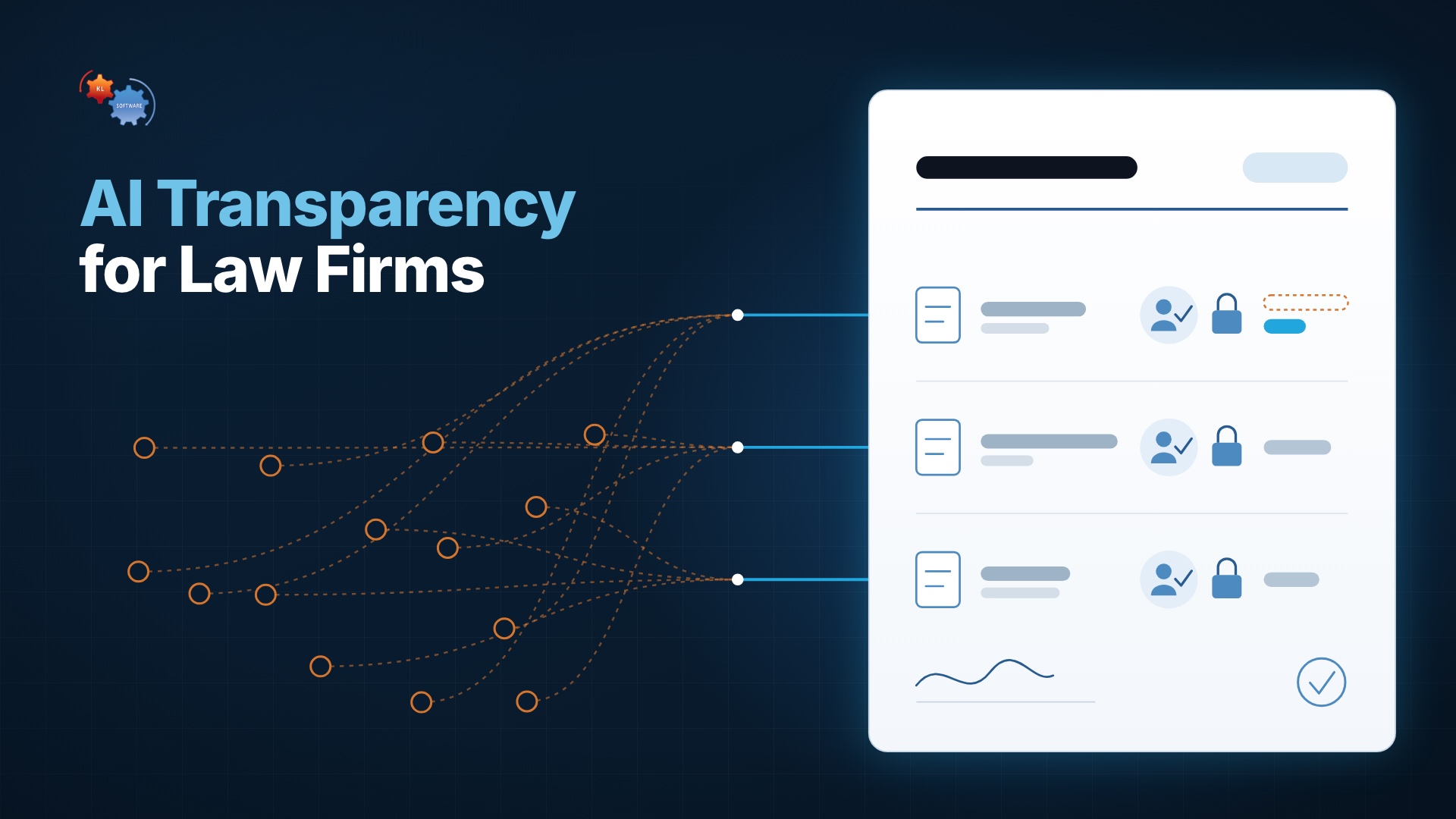
AI Transparency for Law Firms: A Guide for CIOs and Managing Partners
Picture a general counsel at a manufacturing company preparing her annual review of outside firms. She emails each one of three questions. Where are you using AI at work? How do you check what it produces? What are we getting out of it? (An illustrative scenario.)
One partner has good answers in her head, but nothing on paper. AI use at her firm lives in individual habits, so she spends a week asking colleagues what they actually do. The client is not hostile. She is under pressure to show value, and silence is starting to look like absence.
Why Are Clients Asking Law Firms About AI?
Because they are using it themselves.
- The ACC and Everlaw survey of 657 in-house professionals (October 2025) found that generative AI use in corporate legal departments rose from 23% to 52% in one year.
- Yet 59% did not know whether their outside firms use AI on their matters, and 80% were not requiring or encouraging it.
- 64% expect to rely less on outside counsel because of AI.
- Thomson Reuters' 2026 report adds that more than half of corporate legal departments want their firms to use AI, but fewer than one-third know whether their firms do.
Together, these figures describe a quiet gap. Clients want the benefits, cannot see them, and are starting to ask.
What Do Clients Really Want to Know?
Behind every AI questionnaire sit three simple concerns:
- Where is AI used? At the task level: research, review, drafting, summarizing.
- Who checks the work? A named human review step, not a general assurance.
- What do I gain? Faster turnaround, lower cost or better insight.
ABA Formal Opinion 512 adds a professional conduct layer. It says lawyers must consider communicating with clients about AI use, and that informed consent may be needed in some cases, such as when confidential information goes into tools that learn from inputs. Generic engagement letter wording is not enough.
Why Do Most Firms Struggle to Answer?
It is rarely a lack of AI. It is a lack of visibility.
- Use is personal. Each lawyer has their own habits, so no one sees the firm-wide picture.
- Tools sit apart from matter systems. Document management and billing records do not show where AI helped.
- No baseline. Without before-and-after numbers, "faster" is only a claim.
- Mixed messages. Different partners give clients different answers.
How Can a Law Firm Build a Client-Ready AI Story?
Four moves turn scattered AI into something you can explain on one page.
-
Standardize a few workflows. Pick repeatable work such as contract review, due diligence summaries, and compliance checks. Purpose-built AI agents for these tasks give you a process you can describe, not a habit you have to guess at.
-
Connect AI to your systems of record. When AI works inside document management, CRM and time and billing platforms, its use is tied to the matter and can be reported.
-
Keep a simple AI use record. For each practice group, note which tasks, which review step, and where client data is handled. Security and compliance settings built into the setup let a partner answer "where does our data go?" in one sentence.
-
Measure, then share. Capture turnaround times before launch, then report the change. Agree with each client how the efficiency is passed on, whether through speed, fixed fees or insight.
None of this is a pure technology exercise. It is design and integration work across legal workflows and the Microsoft 365 environment, which is why many firms bring in an implementation partner who understands both.
What Does Good Look Like?
Six months later, the same general counsel receives a one-page summary from the firm. It lists three workflows where AI is used, the human review step for each, and a measurable drop in contract review turnaround. She does not ask for a discount. She asks which other matters could use the same approach. (Illustrative.)
FAQs: AI Transparency for Law Firms
Do law firms have to tell clients they use AI?
It depends on the situation. ABA Formal Opinion 512 says lawyers should consider client communication and may need informed consent in some cases. Check your jurisdiction's rules and your client's outside counsel guidelines.
What should a client-facing AI summary include?
Where AI is used, who reviews the output, how client data is handled, and how efficiency gains are shared.
How can firms prove AI value to clients?
Record baseline turnaround before rolling out, then report the change by workflow.
The Bottom Line
Clients are not asking firms to prove they use AI. They are asking firms to show they use it well. The firms that can answer on one page will be the ones that keep the work and win more of it.
Sources
- ACC and Everlaw, Generative AI's Growing Strategic Value for Corporate Law Departments (Oct 2025)
- ACC Docket, The Transparency Gap
- Global Legal Post (23% to 52%, 59% unaware, 80% not requiring)
- Above the Law (64% expect to rely less on outside counsel)
- Thomson Reuters, 2026 AI in Professional Services Report
- ABA Formal Opinion 512 summary