Legal Precedent Search: Stop Rewriting Drafts You Own
Why Your Associates Keep Rewriting Documents Your Firm Already Has
Your firm already won this argument. It just can't remember where it put it.
It's 9:07 PM on a Tuesday. Emily, a second-year associate (an illustrative scenario), has a summary judgment motion due Friday. She is sure a partner argued almost the same thing, in front of this same judge, eighteen months ago. She searches the document system and gets 2,000 results. She opens six. None fit. At 9:40, she opens a blank page.
That brief isn't lost. It's sitting in your system, paid for, proven in court and approved by a client. And your clients are reading invoices with sharper eyes than ever.
Thomson Reuters' 2026 research found that 71% of in-house legal professionals expect outside firms to change their commercial models as AI use grows, while only 28% of law firms say they have changed pricing. That gap is where rebuilt-from-scratch drafting gets exposed.
Why is reinventing the wheel a margin problem now?
Drafting time that clients can't see value in is the first thing to get questioned. The 2026 data shows the pressure building:
- Just 15% of in-house legal professionals expect firm fees to stay flat or rise as AI use increases.
- 32% of in-house legal professionals are already reconsidering firm relationships where AI-enabled value isn't clear, or will do so within 12 months.
- 43% of legal professionals expect hourly billing to decline over the next five years.
Put simply, every hour spent recreating work the firm already owns is an hour that is harder to defend and easier to write down.
Why can't lawyers find precedents that already exist?
The problem is rarely storage. It's findability. In most firms, three things get in the way:
- Keyword search lacks context. "Motion to dismiss" returns thousands of files, with no clue about the judge, forum or outcome.
- Tagging is inconsistent. Each practice group labels documents its own way.
- Quality is invisible. A winning filing and an abandoned draft look the same in the results.
So lawyers improvise. They email a senior colleague, reuse whatever they opened last, or start fresh.
How does guided search fix this?
Think about booking a flight online. You don't scroll through every flight in the world. You filter by date, price and stops, and the list shrinks.
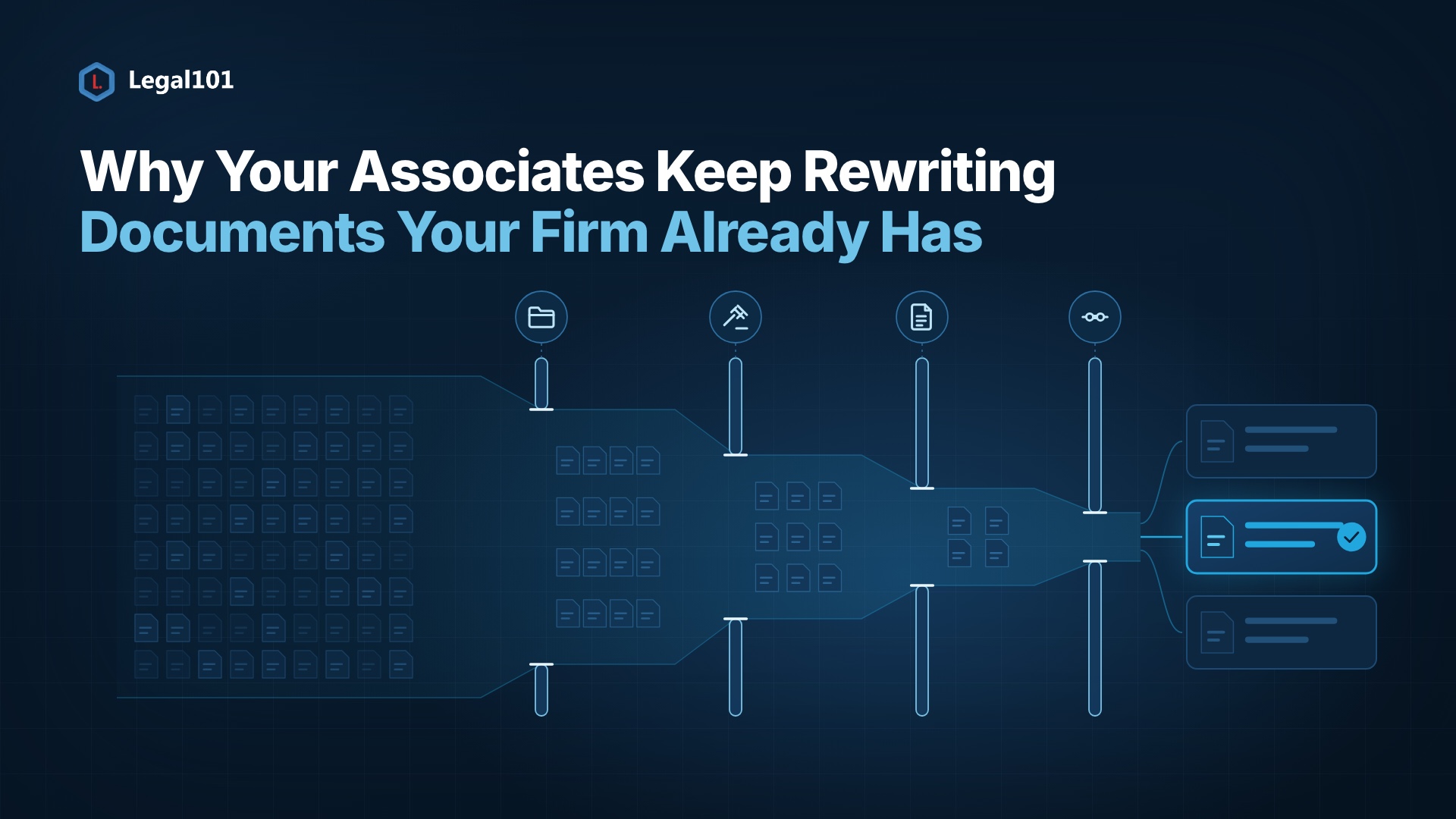
Legal search can work the same way. The lawyer narrows the field step by step:
- Practice area: Commercial litigation
- Judge: The one assigned to the matter
- Motion type: Summary judgment
- Settlement value: The relevant range
A few clicks turn thousands of documents into a short list of the most relevant filings, in seconds instead of hours. Emily starts from a proven draft, adapts it to the facts and is home for dinner.
It works because lawyers already think in facets. They ask who the judge is, what was argued and how it ended. Good search simply mirrors that thinking.
What do firms gain beyond saved time?
- Time and value: Thomson Reuters' 2025 report found professionals expect AI to save about 240 hours a year, around $19,000 per person, adding up to a $32 billion annual impact across US legal and tax. Retrieving existing work is one of the most direct places to capture it.
- Strategy pays off: 64% of professionals say AI meets or exceeds expectations where a clear AI strategy exists, versus 29% where none does.
- Less shadow AI: 34% of professionals use AI tools their organization hasn't sanctioned, and 41% say they lack access to tools built for professional work. When approved tools can't surface firm precedent, lawyers look elsewhere.
- Talent: 24% of law firm professionals would decline a job offer without access to professional-grade AI tools.
How can law firms start?
You don't need a massive transformation. Five moves are enough:
- Measure your own baseline. Sample 20 recent drafts and log time spent finding or rebuilding precedents.
- Pick 4 to 6 filters that match how your partners think.
- Tag at the source. Capture metadata when a document is filed, not months later.
- Show what worked. Flag successful filings, so quality is visible.
- Track write-downs. Compare drafting write-offs before and after.
Quick answers
What is faceted search legal?
It lets lawyers' narrow results through stacked filters such as practice area, judge, motion type and outcome, instead of relying on keywords alone.
How long should a precedent search take?
Second, when filters match how lawyers think.