The Verification Tax: Rethinking AI ROI in Law Firms
The Verification Tax: Rethinking AI ROI in Law Firms and Legal Departments
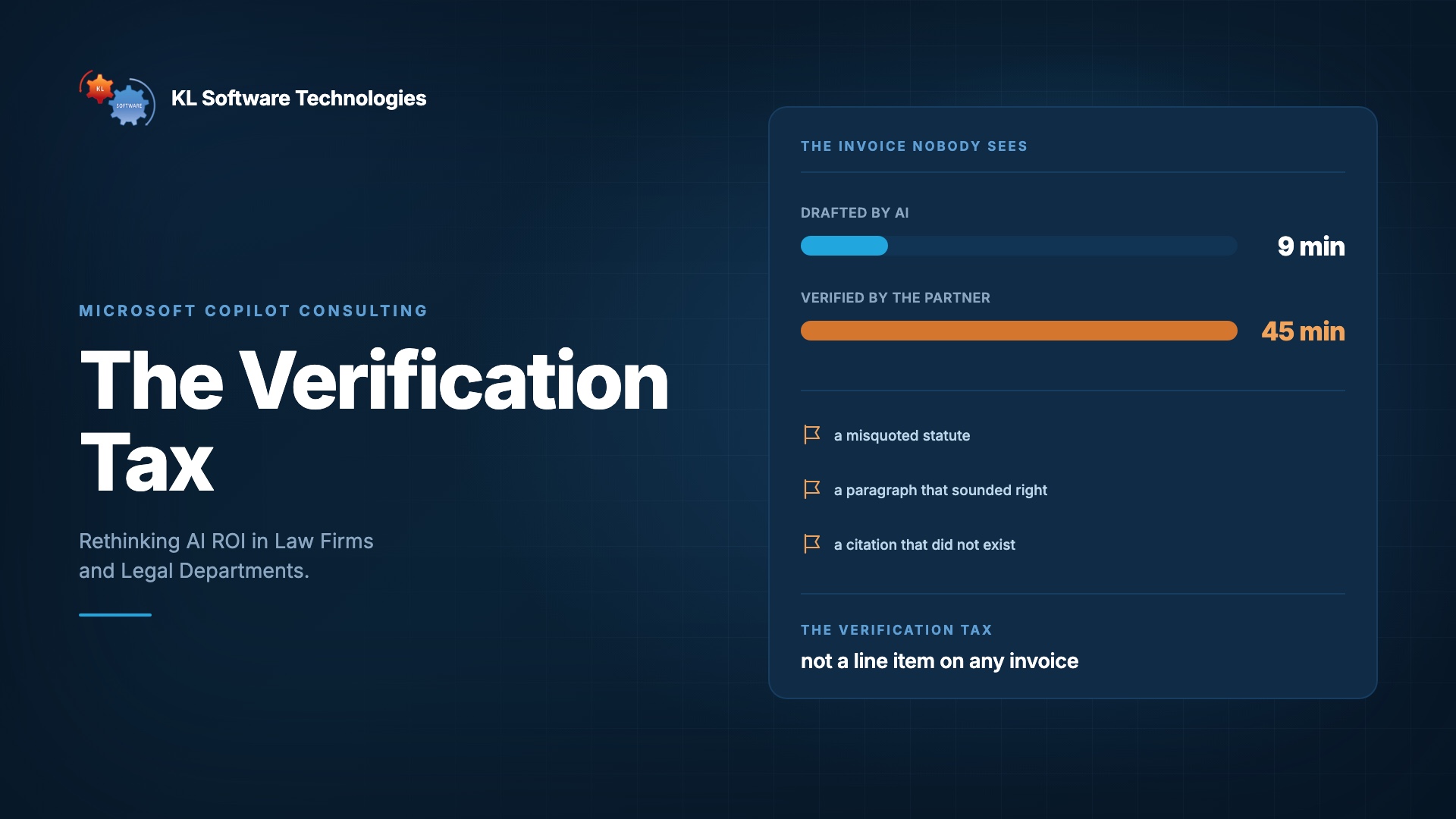
Nine minutes. That is how long it took for the associate to produce a full due diligence memo. AI drafted it, formatted it, even suggested a clause the associate had forgotten to flag. Everyone in the room felt the future arrive.
Then the partner opened it. Forty-five minutes later, she was still in it, chasing down a misquoted statute, rewriting a paragraph that sounded right but meant something slightly wrong, double checking a citation that did not exist anywhere in the record.
The nine-minute miracle had just cost the firm an extra half hour it never used to spend, because nobody used the need to check a first year's work line by line.
This is the verification tax. It is not a line item on any invoice, but every general counsel and managing partner is already paying it.
The Bill Nobody Budgeted For
Here is what should worry you more than any AI headline you read this year. Morae surveyed 850 senior legal professionals globally and found that only a third of them trust the AI assisted legal work output.
Figures as reported by Morae, from the survey of 850 senior legal professionals named above.
So, the industry adopted the tool and kept the old workflow underneath it, fully intact, fully staffed, fully billed.
That is not a transformation. That is just a more expensive first draft.
So, Is It Still Worth It?
This is the question every technology committee avoids instead of answering directly.
The honest answer: it depends entirely on where in the process you are paying the verification tax.
Pay at the back end, catching hallucinations and misfires after a document is already drafted and half approved, and the math turns ugly fast.
The tool worked. The workflow around it did not work.
Pay it at the front end instead, by making sure AI is grounded in your firm's own governed precedent and matter history before it ever generates a sentence, and the entire equation flips.
- Fewer hallucinations to catch.
- Fewer contradictions to untangle.
The tax does not vanish. It just moves somewhere far cheaper to pay for it.
The same tax, and the two places in the process the article says you can pay it.
Move the Tax, Do Not Just Absorb It
This is the shift the most forward-looking legal departments are already making, quietly, without much fanfare.
Instead of pouring more budget into generic AI licenses and hoping the trust gap closes on its own, they are investing in the plumbing: connecting AI directly to governed, firm specific knowledge, the kind that lives inside a properly structured document management environment like iManage or NetDocuments, so the model is reasoning from your actual precedent rather than guessing at it.
Several firms are pairing that groundwork with focused Microsoft Copilot consulting engagements, precisely so Copilot answers what the firm knows instead of what it can plausibly invent.
The Question Worth Asking Before Your Next Renewal
The verification tax is not a verdict against AI. It is a very expensive hint about where your infrastructure still has gaps.
Firms that keep buying more AI without fixing what feeds it will keep paying at the worst possible moment, after the work is already done and the clock is already running.
Firms that fix the foundation first will watch the tax shrink almost on its own, and the ROI conversation stops being a defensive one.
So do not walk into your next technology committee meeting asking whether AI works. Ask something sharper.
Where, exactly, in your own workflow, are you currently paying the tax? And is that really the cheapest place on the entire matter to pay for it?