How Law Firms Can Audit Documents in 48 Hours After a Regulation Changes
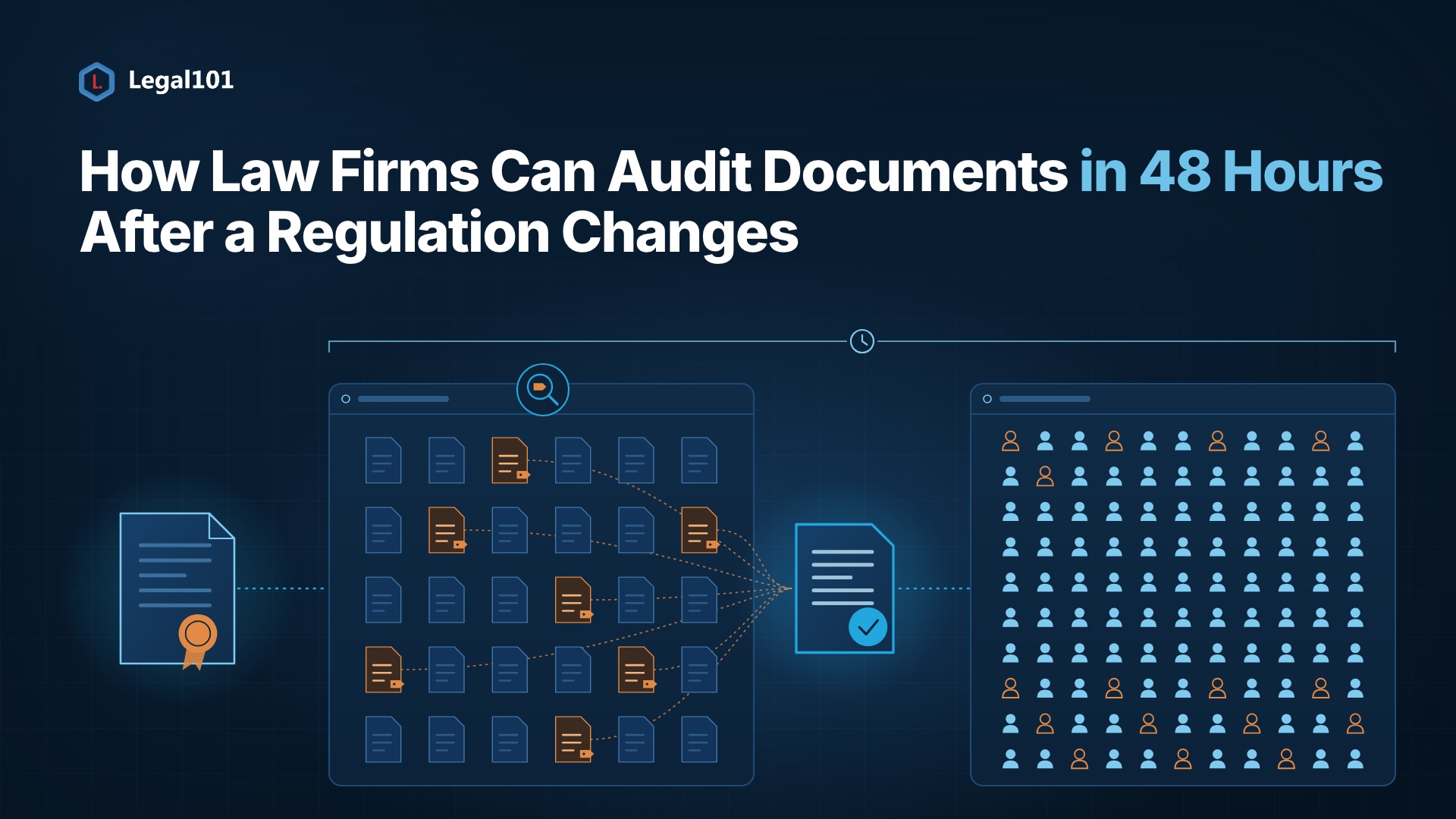
How Law Firms Can Audit Documents in 48 Hours After a Regulation Changes
It is Friday evening. A new privacy amendment has been published. By Monday morning, a client's legal team emails your managing partner: "Have you updated your contracts and guidelines for this change?"
Everyone in the firm now has the same question. Which documents does this rule touch? Where are they? Who is using which version?
For most firms, answering takes weeks. That wait is what we call the regulatory audit scramble.
What Happens in a Law Firm When a Rule Changes
Here is the usual process:
- Compliance reads the new rule and works out what it affects.
- Someone tries to list every template, policy and client guideline that needs a change.
- Emails go out to every practice group asking people to check their files.
- Replies trickle in. Some are late, some are unclear, some never come.
- A spreadsheet tracks who answered. It is out of date by lunchtime.
Nothing in this process is careless. It is simply slow, because the firm cannot see its own documents.
Why Rules Keep Changing (And Why That Matters)
Rules do not sit still. The EU AI Act is a good example. Key obligations for high-risk AI systems were due on 2 August 2026. In May 2026, EU institutions reached a provisional agreement to move them to 2 December 2027, with embedded-product rules moving to 2 August 2028. Other duties, such as transparency, stayed largely on schedule.
So firms are not auditing once. They are auditing again and again, every time a date moves or a rule is amended. A slow process that is tolerable once a year becomes a real burden when it repeats.
The gap shows up in the data too. In the 8am 2026 Legal Industry Report, 43% of legal professionals said their firm has no formal AI policy, and only 9% said a policy exists and is enforced. McKinsey's 2026 AI trust survey found only about one third of organizations have mature governance. If a firm has no clear policy, it cannot update one quickly.
Why Checking Documents After a Change Takes So Long
Three simple problems cause most of the delay:
- Nobody knows where the files are. Copies live in personal OneDrive folders, email attachments and old matter folders.
- Nothing is labelled. You cannot ask the system, "Show me every document that mentions personal data in the EU." Someone has to open files one by one.
- There is no proof. Even after an update, you cannot show who has read it or who is still using the old version.
Think of a recipe copied into twenty notebooks. The chef improves the recipe, but nineteen notebooks stay the same. That is how legal templates behave once they leave the central library.
How to Audit After a Rule Change in 48 Hours
The trick is to do the preparation before the rule changes. Then the audit itself is quick.
Before the change (one-time setup)
- Label your documents. Add simple tags to every policy, precedent and guideline: which regulation, which country, which practice group, who owns it, when it was last reviewed. Microsoft explains that content types bundle this kind of information with templates and can be managed centrally across many sites.
- Keep one master copy. Lawyers open the live version from one place instead of saving their own.
Day 1: Find and fix
- Search by tag. Ask for every document tagged with the changed regulation. The list appears in minutes, not days.
- Update the master. Edit once. Everyone who opens it sees the new version.
Day 2: Tell people and prove it
- Send a targeted notice. Only the practice groups affected get a "must read" message. The tax team is not disturbed by a privacy change.
- Collect confirmations. Each lawyer confirms with one click.
- Watch progress live. Compliance sees who has confirmed and who is still pending, by group and office, and reminders go out automatically.
What This Looks Like in Real Life
Go back to that Monday email. This time, the compliance head opens a dashboard and sees: updated clause live since Saturday, 94 of 110 M&A lawyers confirmed, 16 pending with reminders sent. The reply to the client takes ten minutes. (These figures are illustrative.)
What each leader gains:
- Managing Partners: clear evidence for clients and insurers.
- Operations Directors: less time spent chasing people.
- CIOs and Knowledge Managers: one trusted source instead of hidden copies.
- Heads of Compliance: calm responses instead of emergency ones.
Quick Questions
What is a regulatory audit in a law firm?
It is a check that your templates, policies and client guidelines match the latest rules.
Can we track who has read an update?
Yes, if notices and confirmations live in one governed workspace instead of email.
Do we need to replace our document system?
Not necessarily. Tagging and tracking can sit on top of what you already have.
Start Small
- Pick your ten documents most affected by regulations.
- Agree on five tags, such as regulation, country, practice group, owner and review date.
- Run a pilot with one practice group on the next rule of change and time how long it takes.
Rules will keep changing. The firm's clients trust will not be the ones that never surprise you. They will be the ones that can say, within 48 hours, "We checked; we fixed it, and here is the proof."
Sources
- 8am 2026 Legal Industry Report, via ABA Journal
- McKinsey, State of AI Trust in 2026
- Sidley Austin on the EU AI Omnibus
- Gibson Dunn summary
- Microsoft Support, content types