Speed-to-Intake: Removing Hidden Friction in Law Firm Conflict Clearance
Speed-to-Intake: Removing Hidden Friction in Law Firm Conflict Clearance
Conflict checks quietly decide which clients a law firm keeps. Here is why the delay happens, and how firms are fixing it.
A general counsel calls with an urgent matter. It is the kind of case every firm wants: high value, long term, a client worth keeping. Your partner is excited. Then someone asks the one question that can stall everything: has this firm ever worked for the other side?
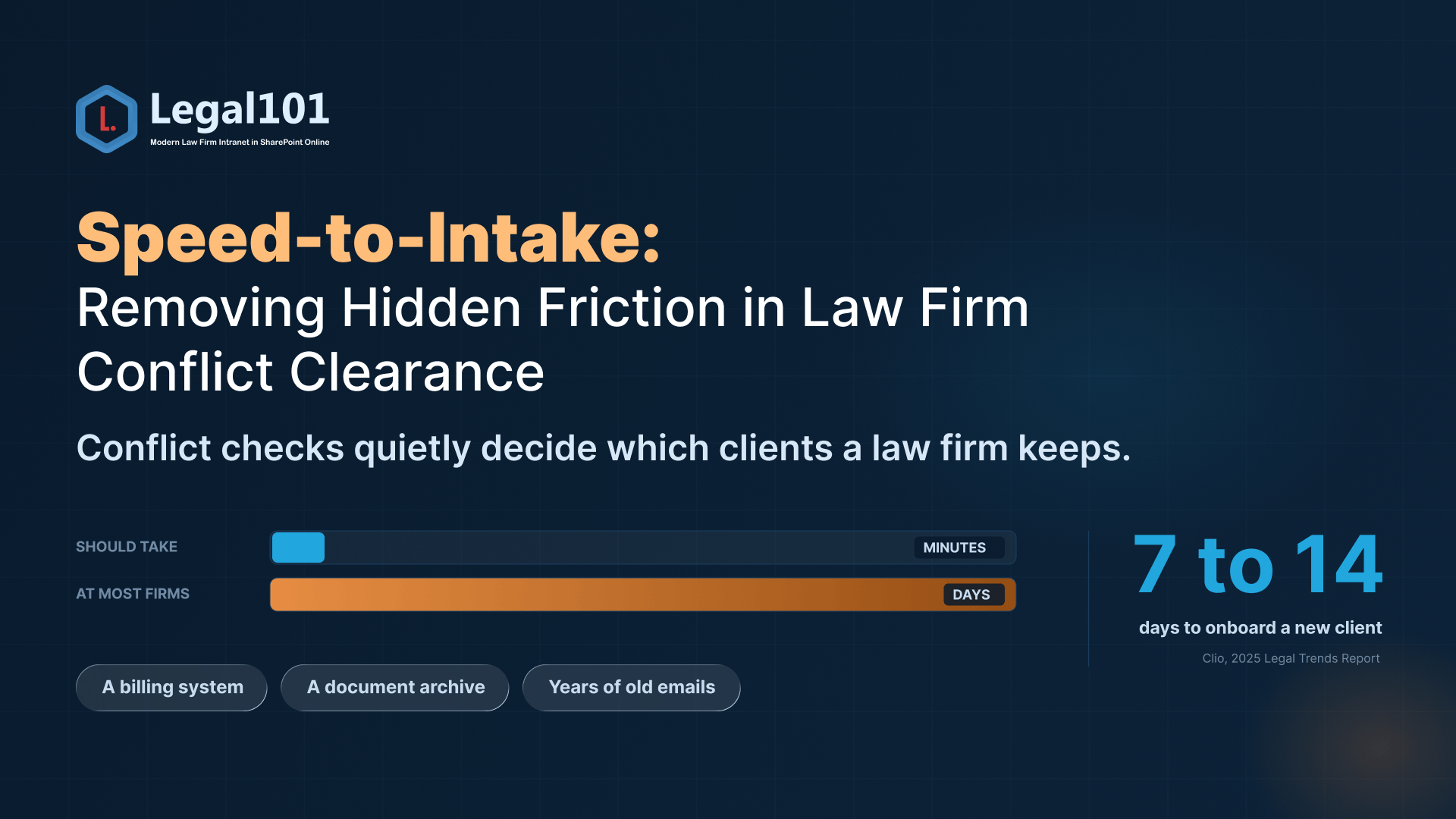
That question should take minutes to answer. At most firms, it takes days. The answer is scattered across a billing system, a document archive, and years of old emails that nobody has fully searched. By the time the firm clears the conflict, the client has already signed with someone faster.
This happens more often than firms like to admit. And it is costing them real business.
The Hidden Cost of a “Simple” Check
Conflict checks exist for a good reason. They protect clients and protect the firm. But the process has quietly become a bottleneck, and the numbers back this up.
Clio’s 2025 Legal Trends Report found that new client onboarding takes seven to fourteen days on average, and conflict clearance is a big part of that window.
Thomson Reuters surveyed corporate legal buyers and found that 41 percent said slow onboarding made them think less of a firm’s competence, even when the legal work itself was excellent.
The Thomson Reuters Institute’s 2026 State of the Corporate Law Department Report shows that 81 percent of legal departments are handling more matters, while 55 percent have flat or shrinking budgets. They do not have time to wait.
For a corporate counsel with too much work and too little time, a firm that cannot confirm availability in a day is simply not an option.
Why It Keeps Happening
The problem is rarely the people. Conflicts teams work hard. The problem is where the data lives.
- Client and matter history sits in the billing or practice management system.
- Prior correspondence sits in a separate document archive.
- Related party details, such as spouses, subsidiaries, or co-defendants, sit buried in notes and inboxes nobody has searched in years.
To clear a new client, someone has to check all three, by hand, and hope nothing was missed. One misspelled subsidiary name can let a real conflict slip through, or cause a firm to turn away good business out of caution.
This gap is not unique to law firms. McKinsey’s latest global AI survey found that 88 percent of organizations now use AI somewhere in their business. But two out of three have not scaled a single use case past the pilot stage. The tools exist. What is missing is data that is organized well enough for AI to actually use.
What Actually Fixes This
Firms that solve this problem are not hiring more conflicts staff. They are connecting the systems that already hold the answer.
When a firm’s CRM, document archive, and billing records sit behind one searchable layer, a risk manager can check every past matter, every named party, and every related entity in one search. Minutes, not days. The system catches naming variations a person might miss. And every search leaves a clear record, which matters for defending the firm’s process later, not just for speed.
The shift is already happening. Thomson Reuters reports that generative AI use jumped from 28 to 41 percent among law firms, and from 23 to 47 percent among corporate legal departments, in a single year. The firms pulling ahead are not just using AI for drafting and research. They are pointing it at the unglamorous steps, like intake, where speed actually wins clients.
The Question Worth Asking
Clients rarely pick a firm because it cleared a conflict check fast. But they notice right away when a firm cannot.
For CIOs, knowledge managers, and risk committees, the real question this quarter is not whether your firm has AI. It is whether your firm’s own history, every matter, every party, every past engagement, is organized well enough for that AI to answer one simple question fast: can we take this client?
The firms that can say yes in an hour are the ones winning the calls that matter.